
This page documents the application of the Complete Data Fusion (CDF) algorithm to the MIPAS / IFAC-CNR ozone profile product. MIPAS is a limb-sounding instrument that retrieves multiple atmospheric species simultaneously. The CDF test is applied to the full multi-target state vector (O3 + temperature + pressure, 91 parameters), making MIPAS a representative example of a complex optimal-estimation retrieval within the CDF framework.
1. Overview
| Provider | IFAC-CNR — Istituto di Fisica Applicata “Nello Carrara”, Consiglio Nazionale delle Ricerche, Florence, Italy (Atmosphere Group, ga.ifac.cnr.it) |
| Instrument | MIPAS (Michelson Interferometer for Passive Atmospheric Sounding) — limb emission sounder |
| Platform | Envisat (ESA) — sun-synchronous orbit, ≈ 800 km altitude |
| Retrieval algorithm | ORM V8 (Optimised Retrieval Method, version 8.xx) — global-fit optimal estimation, simultaneous retrieval of O3, temperature and pressure |
| Measured constituents | O3 (primary), T, p (jointly retrieved — full multi-target state vector) |
| File format | netCDF — extended format (MIPAS_2PE_) |
| CDF status | Tested — completeness and auto-consistency tests passed for both CDF(2022) and CDF(2015) |
2. FAIR References
The MIPAS/IFAC-CNR product is an internal reprocessing by IFAC-CNR of ESA Envisat/MIPAS Level 1B data and is not publicly distributed through an open catalogue. The following references are derived from the global attributes of the test file. Verified on 2026-04-11 against the file metadata.
| Product title | Level 2 MIPAS products — extended file (O3) |
| Institution | CNR — Istituto di Fisica Applicata “N. Carrara” (IFAC), Florence |
| Processor version | ORM_V8.xx — auxiliary data version: 9.xx |
| Output data definition | IFAC_GA_2018_1_FB issue:2.0 — MIPAS L2 V8 output data definition |
| DOI / persistent identifier | Not assigned — internal IFAC-CNR reprocessing dataset. |
| ESA mission reference | ESA MIPAS products and algorithms information |
| Contact | ga@ifac.cnr.it |
| License / data policy | Internal PNRR project use. Contact IFAC-CNR for access conditions. |
3. Dataset Description
MIPAS was a Fourier transform spectrometer on board ESA’s Envisat satellite (launched March 2002, lost contact April 2012). Operating in the thermal infrared (4.15–14.6 μm), MIPAS performed limb emission sounding and could retrieve vertical profiles of multiple atmospheric species simultaneously in the stratosphere and upper troposphere.
The IFAC-CNR Level 2 processor (ORM V8) performs a global-fit optimal estimation retrieval, jointly retrieving ozone (O3), temperature (T) and pressure (p) from a full orbit of limb scans. The retrieval product is distributed as an “extended” netCDF file (MIPAS_2PE_) containing the full characterisation of the retrieval: the complete state vector, the full averaging kernel matrix, and the full covariance matrices for all retrieved parameters.
Two MIPAS measurement modes were used during the mission:
| Mode | Period | Spectral resolution | Vertical coverage |
|---|---|---|---|
| Full Resolution (FR) | 2002 – 2004 | 0.025 cm-1 | ~6 – 68 km |
| Reduced Resolution (RR) | 2005 – 2012 | 0.0625 cm-1 | ~6 – 70 km |
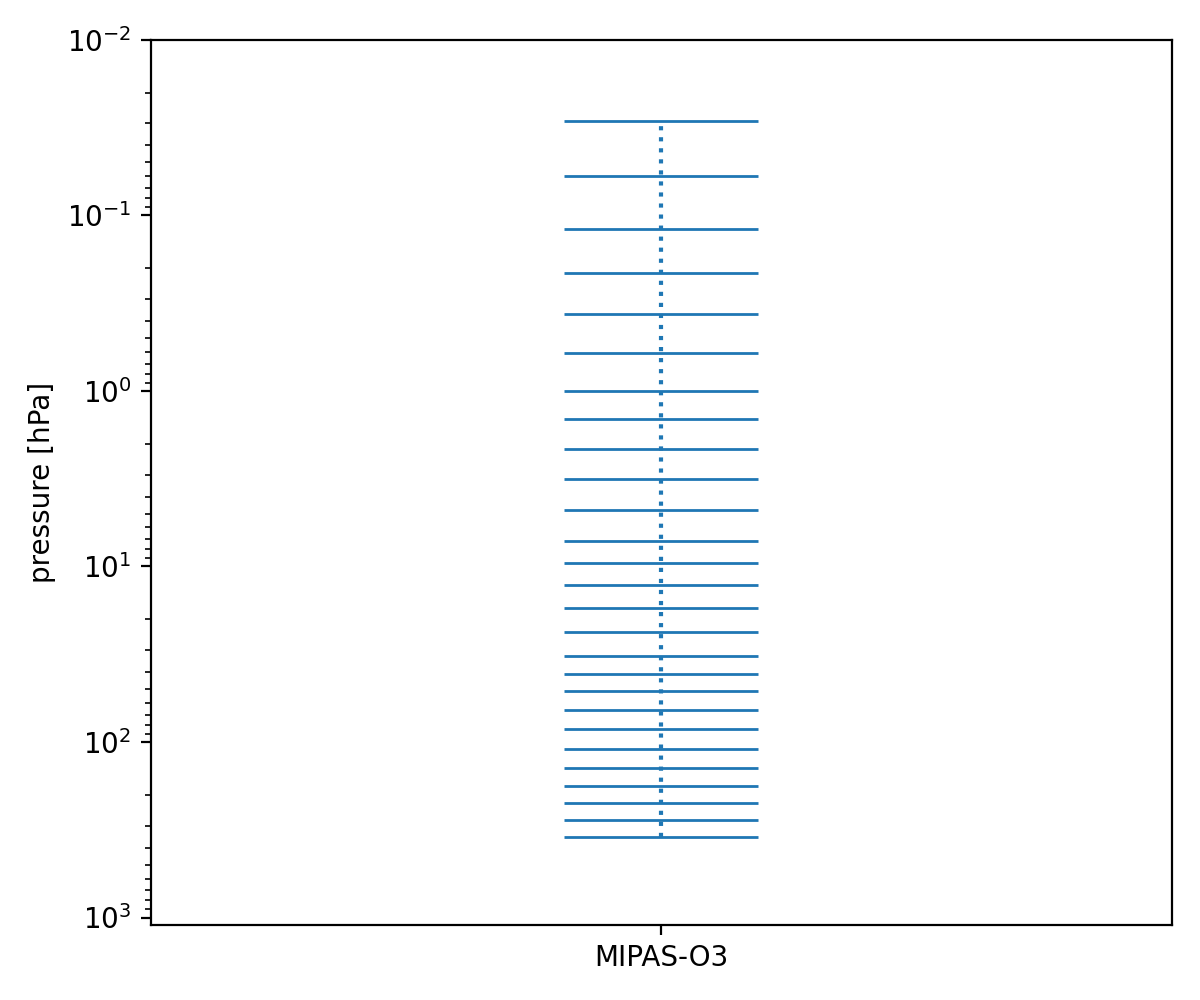
The test file belongs to the RR period (January 2008). The product covers global latitudes; each orbit file contains approximately 90 individual limb scans.
4. State Vector
The MIPAS/ORM V8 state vector is a multi-target retrieval (MTR) containing 91 parameters in total:
- 27 O3 volume mixing ratio levels (on the tangent height grid)
- 27 temperature levels
- 27 pressure levels
- 10 additional parameters (continuum emission and/or other micro-windows parameters)
All 91 parameters are retrieved jointly in a single optimal estimation inversion, and the full 91 × 91 averaging kernel and covariance matrices are stored in the product file. For the CDF application, the full 91-element state vector and the corresponding 91 × 91 characterisation matrices are used — this distinguishes MIPAS from the nadir-sounding datasets where only O3 partial columns are retrieved.
The covariance matrices are stored in the netCDF file in compressed lower-triangular form (vector of length cmdim = 4186 = 91 × 92 / 2) and are reconstructed as full symmetric matrices by the MipasNetcdfReader.
5. Test File
The test file is a Reduced Resolution netCDF orbit file:
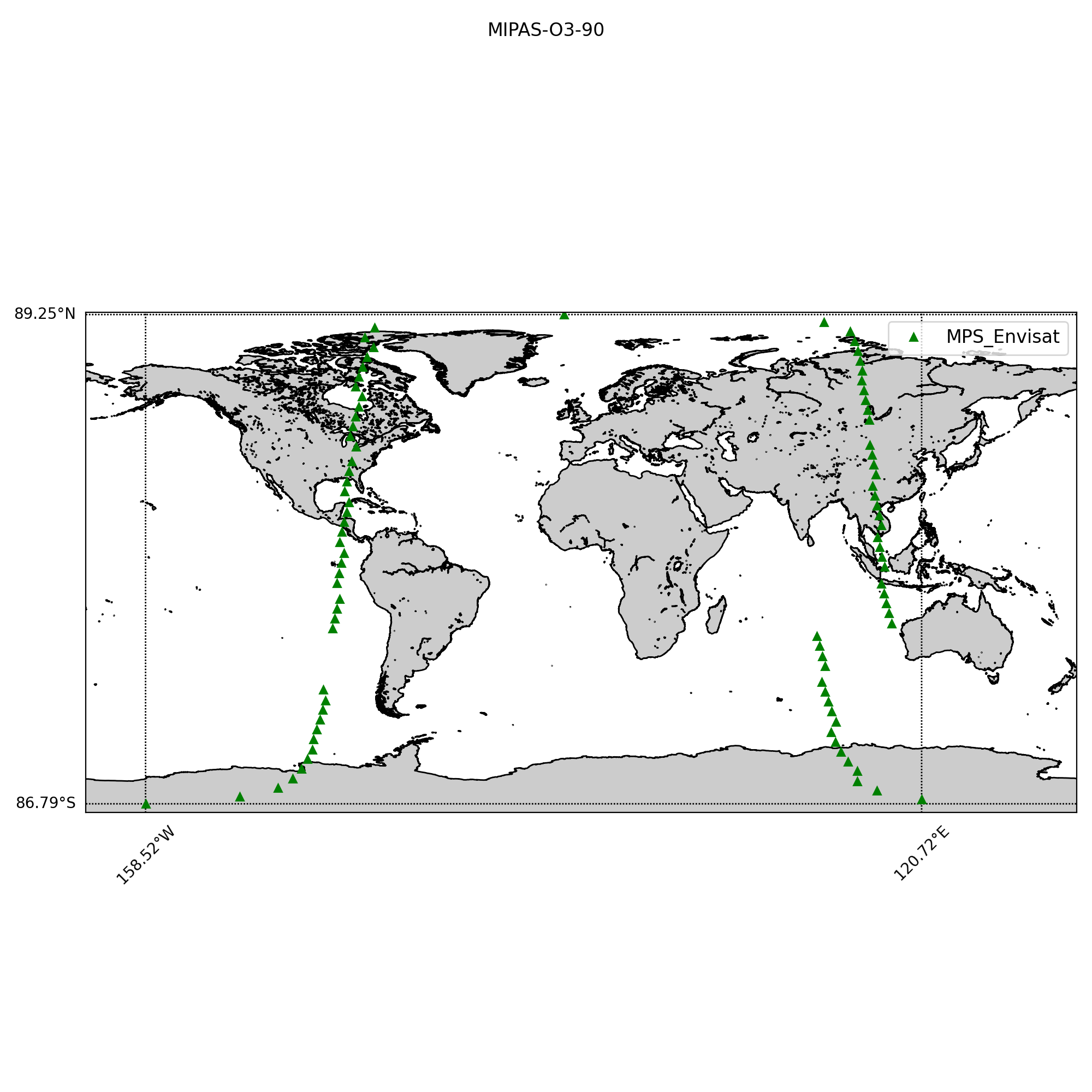
MIPAS_2PE_O3______20080101T150614_20080101T164637_30526_11.nc
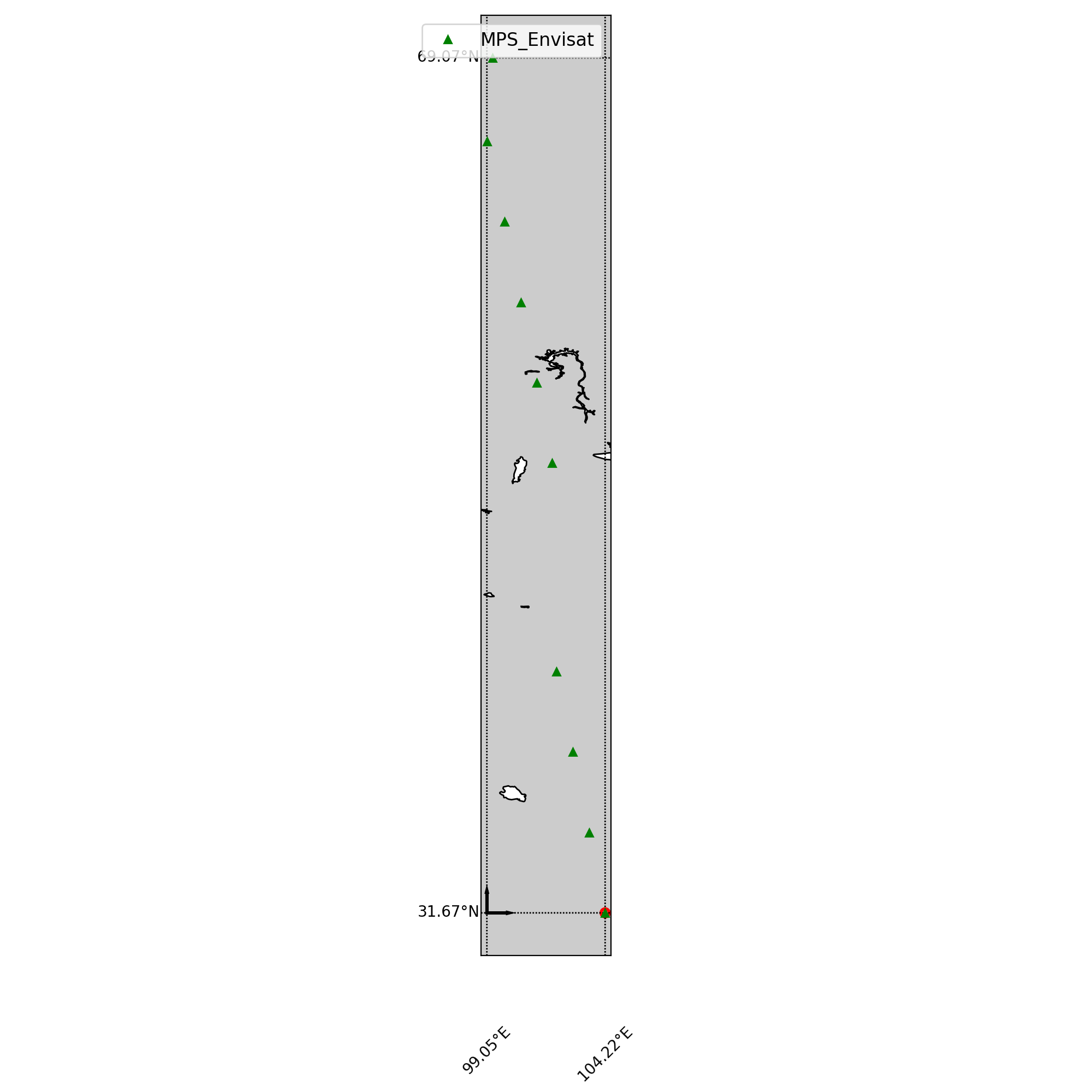
This file covers orbit 30526 of 1 January 2008 (15:06 – 16:46 UTC). It contains 90 limb scans; all products are used (no explicit quality filtering in the test script). The average distance between neighbouring scan positions reflects the typical MIPAS along-orbit sampling of ≈ 500 km between scans.
6. Completeness Test Results
All completeness tests are passed. The full multi-target characterisation matrices (AKM and both covariance matrices) are stored explicitly in the netCDF file, making MIPAS/IFAC one of the most complete products in terms of CDF requirements.
| # | Requirement | Result |
|---|---|---|
| 1 | Optimal estimation retrieval | ✓ |
| 2 | Full state vector available | ✓ |
| 3 | Vertical profiles in terms of concentrations or partial columns | ✓ |
| 4 | Vertical grid availability | ✓ |
| 5 | Full a priori state vector availability | ✓ |
| 6a | Averaging kernel availability (full state vector) | ✓ |
| 6b | Total errors covariance matrix availability | ✓ |
| 6c | A priori covariance matrix availability | ✓ |
All three matrices (AKM, total covariance, a priori covariance) are stored explicitly in the file in compressed lower-triangular form and reconstructed as full 91 × 91 matrices by the reader. No external files or computed approximations are needed.
7. Auto-consistency Test Results
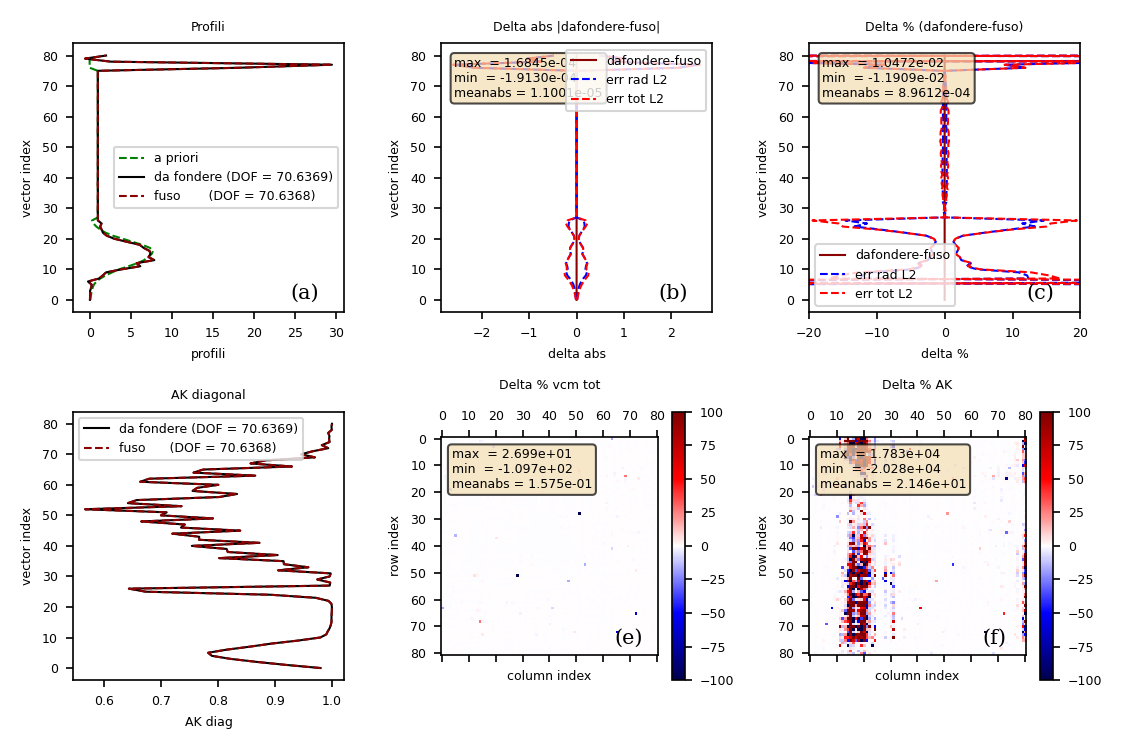
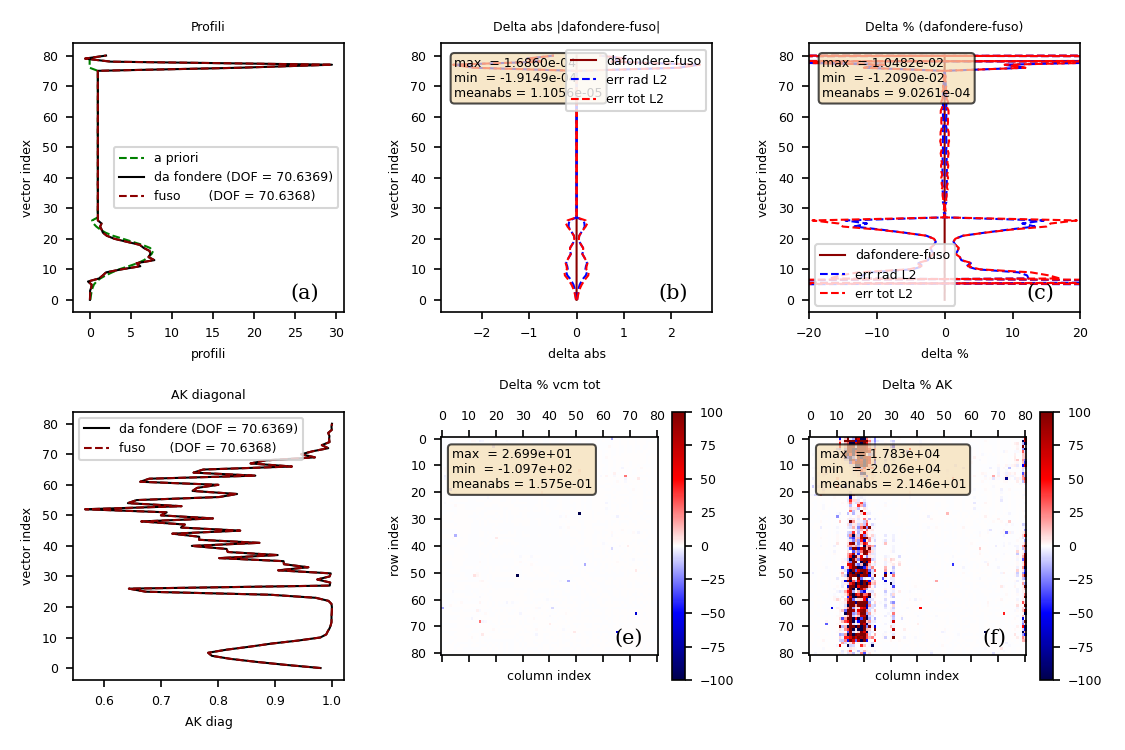
The auto-consistency test has been applied to the product under test in both the CDF(2022) and CDF(2015) formulations. In the CDF(2022) formulation, the direct matrix inversion is used without regularisation (rcond = 0). In the CDF(2015) formulation, the pseudo-inversion of \mathbf{S}_{ni} retains only eigenvalues within eleven orders of magnitude of the largest one (rcond = 1e-11). Both formulations pass.
| # | MIPAS-IFAC-O3 Auto-consistency test results | \max(|\Delta x|)\% | (|\Delta\mathrm{DOFs}|)\% |
|---|---|---|---|
| 1 | CDF(2022) total error VCM inversion | 0.011909 | 0.000034 |
| 2 | CDF(2015) noise error VCM inversion | 0.012090 | 0.000034 |
8. CDF Variables Mapping
The following table lists the quantities required by the CDF algorithm and their exact location in the MIPAS/IFAC extended netCDF file, as implemented by the MipasNetcdfReader class used in the test script (05_PNRR_filetest/09_MIPAS_O3_OE.py).
| CDF quantity | Symbol | Reader attribute | netCDF variable |
|---|---|---|---|
| Full retrieved state vector (91 parameters: O3 + T + p + continuum) |
\widehat{\mathbf{x}} | p.o3 |
state_vector (time, parameters=91) |
| Full a priori state vector | \mathbf{x}_{a} | p.o3_apriori |
a_priori_state_vector (time, parameters=91) |
| A priori covariance matrix (reconstructed from lower-triangular storage) |
\mathbf{S}_{a} | p.vcm_a |
a_priori_full_covariance (time, cmdim=4186) |
| Total error covariance matrix (reconstructed from lower-triangular storage) |
\mathbf{S}_{n} | p.vcm_total |
full_covariance_matrix (time, cmdim=4186) |
| Averaging kernel matrix | \mathbf{A} | p.ak |
full_averaging_kernel (time, parameters=91, parameters=91) |
| Vertical grid (pressure) | — | p.pressure |
pressure (time, level=27), units: hPa |
| Vertical grid (altitude) | — | p.z |
height (time, level=27), units: km |
Note on triangular storage: the variables full_covariance_matrix and a_priori_full_covariance store only the lower triangle of the symmetric matrix as a 1-D vector of length cmdim = n(n+1)/2 where n = 91. The reader reconstructs the full 91 × 91 matrix element-by-element using the index mapping mapij2diag(i,j).
Note on grid orientation: the reader applies flipgrid=True by default to reverse the vertical ordering of the profile from the native file convention (top-to-bottom) to the standard bottom-to-top ordering expected by the CDF code.
9. Notes and Open Issues
- MIPAS/IFAC is the only dataset in this project where the CDF is applied to a full multi-target state vector (91 parameters including T and p), rather than to O3 only. This makes the AKM and VCM significantly larger and more complex than for nadir-sounding instruments.
- The Envisat mission ended on 8 April 2012; the MIPAS/IFAC archive therefore covers 2002–2012. No future data will be produced with this instrument.
- The product is an internal IFAC-CNR reprocessing and is not available through a public open-data portal. Access requires direct contact with the IFAC-CNR Atmosphere Group (ga@ifac.cnr.it).
Back to: Tested Datasets overview.