
This page documents the application of the Complete Data Fusion (CDF) algorithm to the GOME-2 / AC SAF ozone profile product. It reports the FAIR references of the dataset, a summary of its main characteristics, and the results of the completeness and auto-consistency tests performed on a representative test file.
1. Overview
| Provider | AC SAF — Atmospheric Composition Satellite Application Facility (EUMETSAT SAF network) |
| Instrument | GOME-2 (Global Ozone Monitoring Experiment–2), nadir scanning |
| Platforms | Metop-A, Metop-B, Metop-C |
| Product | Offline high-resolution vertical ozone profile (OHP) |
| Measured constituents | O3 |
| File format | HDF5 |
| CDF status | Tested — completeness and auto-consistency tests passed |
2. FAIR References
The following references allow the dataset to be uniquely identified, accessed, and cited according to FAIR (Findable, Accessible, Interoperable, Reusable) principles. Verified on 2026-04-11 against the AC SAF and EUMETSAT official portals.
| Persistent identifier | EO:EUM:DAT:0646 (EUMETSAT product code) |
| DOI | Not assigned by AC SAF for this product (verified 2026-04-11). |
| Product version | v2.20 — operational since 30/04/2024 for Metop-B and Metop-C |
| Product landing page | https://acsaf.org/products/ohp.php |
| Data access (offline) | https://acsaf.org/offline_access.php |
| EUMETSAT catalogue record | https://user.eumetsat.int/catalogue/EO:EUM:DAT:0646 |
| Algorithm Theoretical Basis Document (ATBD) | ATBD NHP/OHP/O3Tropo — Nov 2022 |
| Product User Manual (PUM) | PUM NHP/OHP/O3Tropo — Nov 2022 |
| License / access conditions | Free of charge. Data are owned by EUMETSAT and distributed under the AC SAF data policy. |
| Required acknowledgement (scientific publications) | “We thank the AC SAF project of the EUMETSAT for providing data and/or products used in this paper.” |
3. Dataset Description
The AC SAF (Atmospheric Composition Satellite Application Facility) is a project under the EUMETSAT Satellite Application Facility network. It focuses on processing, archiving, and disseminating satellite data related to the Earth’s atmospheric composition. AC SAF consortium members develop radiative transfer calculation methods and other algorithms for creating atmospheric remote sensing data from the polar-orbiting satellites Metop-A, Metop-B and Metop-C.
The analysed dataset is the offline high-resolution vertical ozone profile product, which provides, from the GOME-2 nadir scanning mode:
- The retrieved ozone profile
- The full error covariance matrix
- The retrieval noise covariance matrix
- The a priori profile
- The averaging kernels
- Retrieved auxiliary parameters (e.g. surface albedo, cloud albedo)
The availability of the dataset depends on the platform:
| Platform | Temporal coverage |
|---|---|
| Metop-A | 23/01/2007 – 15/11/2021 |
| Metop-B | 12/12/2012 – ongoing |
| Metop-C | 14/09/2020 – ongoing |
The nominal spatial resolution is 40 × 80 km2, except for Metop-A between July 2013 and November 2021, when it was 40 × 40 km2.
4. State Vector
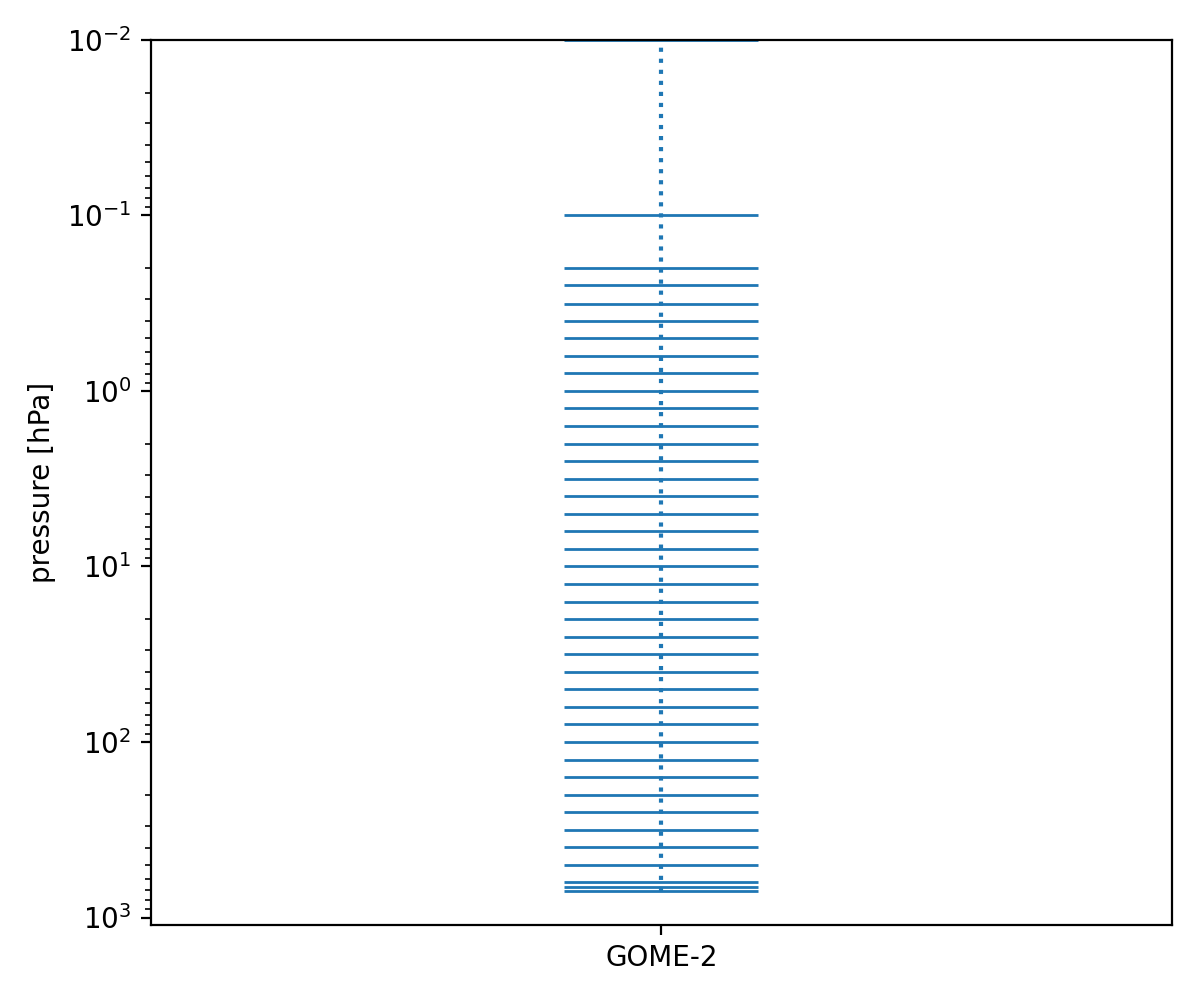
The state vector is composed by 42 elements:
- Partial columns profile of O3 in Dobson Units — 40 elements
- Albedo — 1 element
- Calibration error — 1 element
For the specific product selected as reference, the ratio between the largest and the smallest element of the state vector is approximately 1.707 × 10⁵, indicating a wide dynamic range that is relevant for numerical aspects of the CDF computation.
5. Test File
The test file used for the CDF tests on this dataset is a Metop-B HDF5 file (≈ 250 MB) with name:
S-O3M_GOME_OHP_02_M01_20191226083256Z_20191226092956Z_N_O_20191226162125Z.hdf5
Quality filtering: only products with DATA/QualityProcessing[0,:] == 1 have been considered, resulting in 11 299 valid products. The average distance between each pixel and its nearest neighbour is 39.54 km (across track), with an along-track distance of approximately 80 km — consistent with the nominal 40 × 80 km2 resolution.
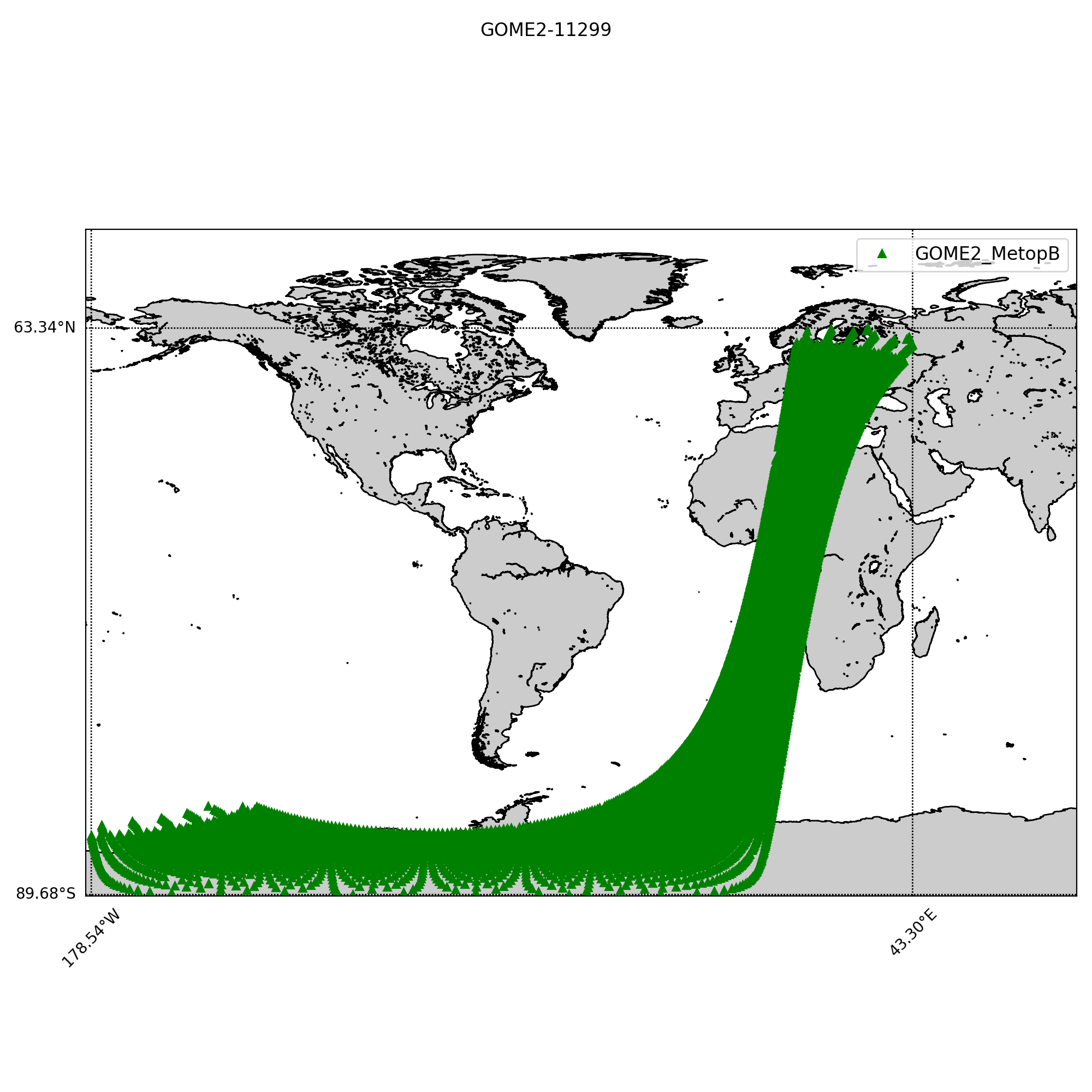
DATA/QualityProcessing[0,:] == 1.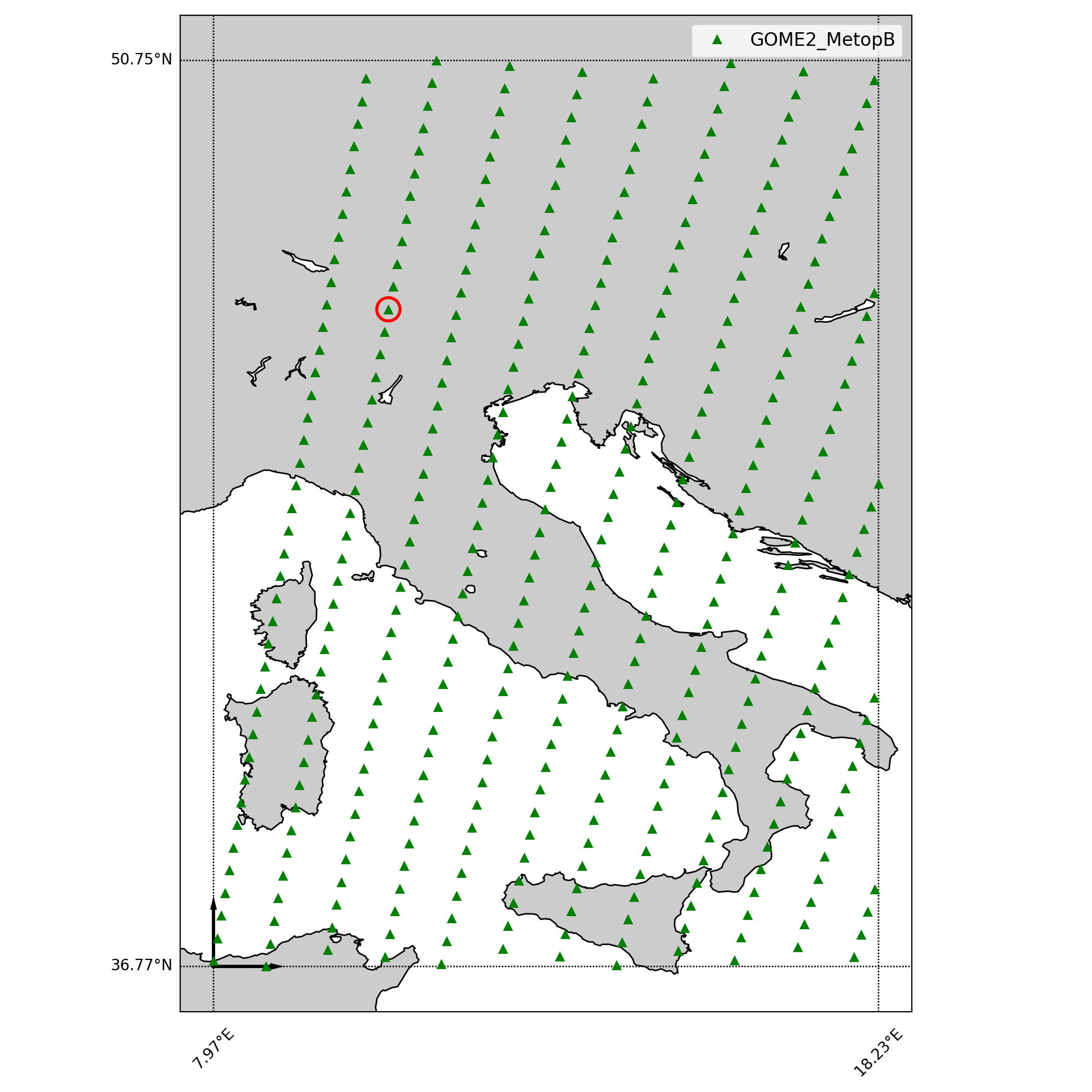
6. Completeness Test Results
All the completeness tests are passed. In particular, all the quantities needed for the CDF are stored in the HDF5 file without compression.
| # | Requirement | Result |
|---|---|---|
| 1 | Optimal estimation retrieval | ✓ |
| 2 | Full state vector available | ✓ |
| 3 | Vertical profiles in terms of concentrations or partial columns | ✓ |
| 4 | Vertical grid availability | ✓ |
| 5 | Full a priori state vector availability | ✓ |
| 6a | Averaging kernel availability (full state vector) | ✓ |
| 6b | Total errors covariance matrix availability | ✓ |
| 6c | A priori covariance matrix availability | ✓ |
7. Auto-consistency Test Results
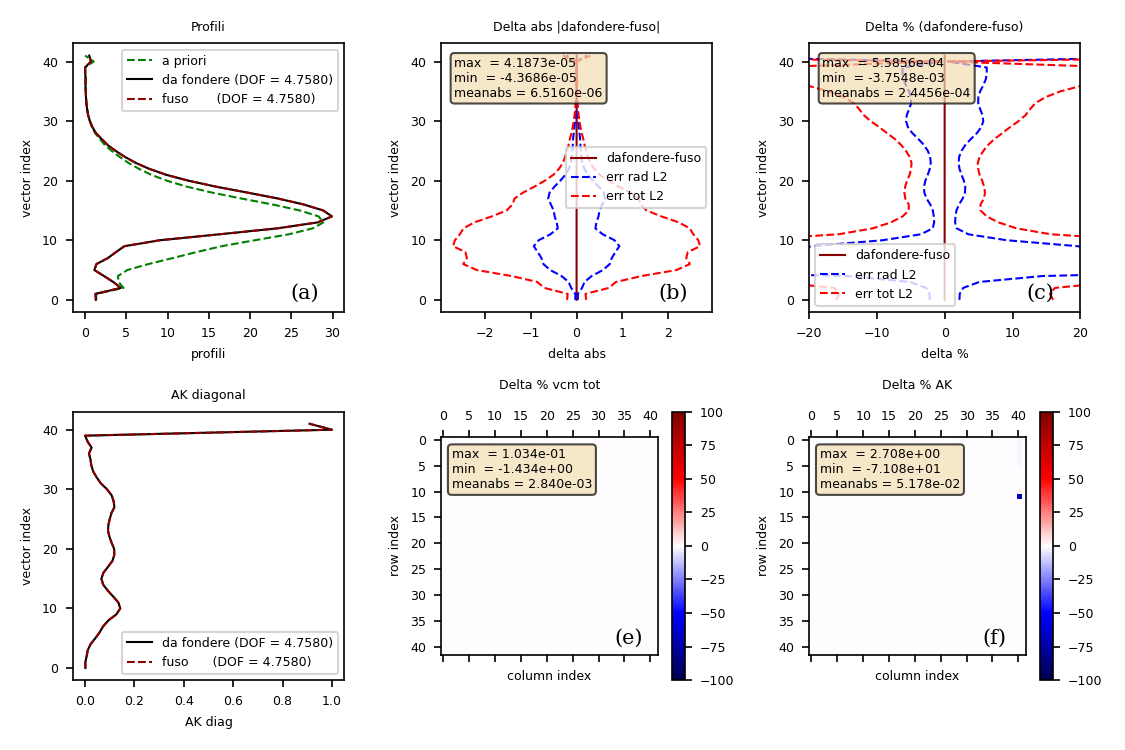
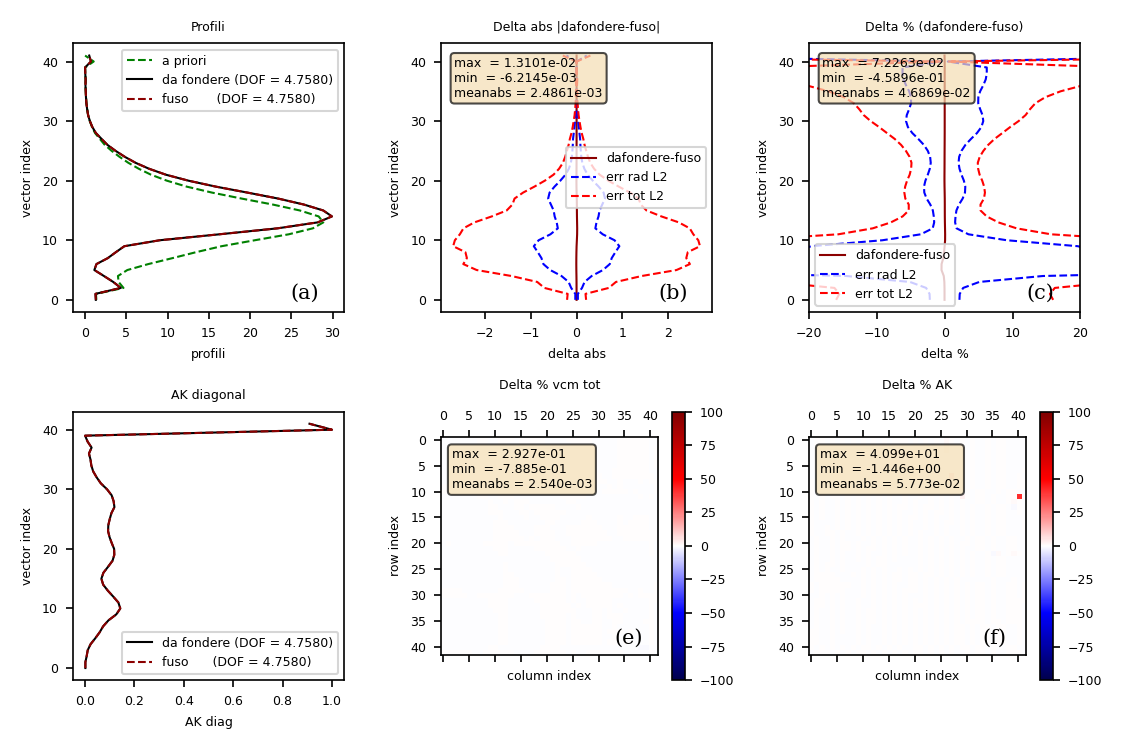
The auto-consistency test has been applied to the product under test in both the CDF(2022) and CDF(2015) formulations. The results are summarized in the table below and represented in Figure 4 for CDF(2022). In the CDF(2015) formulation, the pseudo-inversion of mathbf{S}_{ni} considered only the eigenvalues larger than fifteen orders of magnitude below the largest one.
| # | GOME-2 Auto-consistency test results | max(|Delta x|)% | (|Deltamathrm{DOFs}|)% |
|---|---|---|---|
| 1 | CDF(2022) total error VCM inversion | 0.002504 | 0.000000 |
| 2 | CDF(2015) noise error VCM inversion | 0.456911 | 0.000029 |
8. CDF Variables Mapping
The following table lists the quantities strictly required by the CDF algorithm and their exact path inside the GOME-2/AC-SAF HDF5 file, as implemented by the GOMEhdf5Reader class used in the test scripts.
| CDF quantity | Symbol | Reader attribute | HDF5 variable path |
|---|---|---|---|
| Retrieved state vector (40 O3 partial columns + albedo + calibration error) |
widehat{mathbf{x}} | p.o3 |
DATA/StateRetrieved |
| A priori state vector | mathbf{x}_{a} | p.o3_apriori |
DATA/Apriori |
| A priori covariance matrix | mathbf{S}_{a} | p.vcm_a |
DATA/AprioriErrorCovariance |
| Total error covariance matrix (used as mathbf{S}_{n} in the GOME-2 CDF test) |
mathbf{S}_{n} | p.vcm_total |
DATA/ErrorCovarianceTotal |
| Averaging kernel matrix | mathbf{A} | p.ak |
DATA/AveragingKernel |
| Vertical grid (pressure levels) | — | p.pressure |
DATA/OutputPressureGrid |
Note: the HDF5 file also provides DATA/ErrorCovarianceNoise, which could be used as mathbf{S}_{n}. The current GOME-2 test script uses DATA/ErrorCovarianceTotal instead, consistent with the treatment of the total retrieval error as the effective noise term in the auto-consistency test.
9. Notes and Open Issues
- The wide dynamic range of the state vector (≈ 105) requires careful handling of matrix inversions in the CDF equations — see the Extensions page for a discussion of numerical aspects.
- All characterisation matrices (AKM, noise VCM, a priori VCM) are stored uncompressed in the HDF5 file and are directly usable by the CDF code without pre-processing.
Back to: Tested Datasets overview.