
A New Ozone Dataset to Understand Stratospheric Intrusions: Inside the Latest AMT Publication
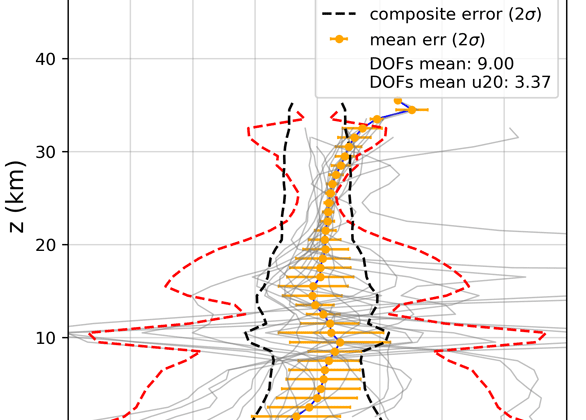
Monitoring the Earth’s ozone layer—especially in the complex region where the upper troposphere meets the lower stratosphere (UTLS)—remains one of the biggest challenges in atmospheric science. A recent study published in Atmospheric Measurement Techniques introduces a breakthrough: a new fused ozone dataset created using Complete Data Fusion (CDF) applied to measurements from the MIPAS and IASI satellite instruments. This innovative approach brings unprecedented clarity to ozone behavior over the Himalayas, a hotspot for stratospheric intrusion events.
Guidetti et al. (2026) developed an ozone dataset by combining:
MIPAS limb observations aboard ESA’s Envisat satellite, and
IASI nadir observations aboard EUMETSAT’s MetOp satellites.
These instruments operated simultaneously between 2008 and 2011, providing complementary views of the atmosphere.
This fusion—using the Complete Data Fusion algorithm—enhances our ability to detect and quantify ozone variations in the UTLS, a region crucial for understanding climate interactions and air quality.
Why Combine MIPAS and IASI?Each instrument sees the atmosphere differently:
MIPAS provides high-vertical-resolution limb sounding but with limited spatial coverage.
IASI delivers dense global coverage...