Tested Datasets

Tested Datasets

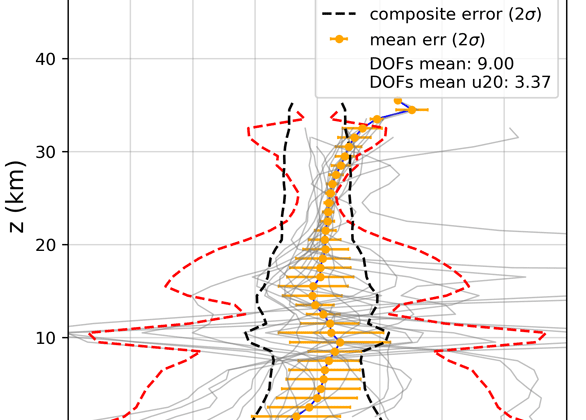
The Tested Datasets section of this website has been updated. It collects the atmospheric retrieval products for which the Complete Data Fusion (CDF) algorithm has been applied and verified as part of the EMM project. For each dataset — identified by instrument, provider, and processing chain — we document: FAIR references (persistent identifiers, access URLs, data documentation, citation) General product description (constituents, vertical grid, state vector, file format) Results of the completeness and auto-consistency tests Mapping between CDF-required quantities and actual variable names in the data files The auto-consistency test results should be read as data quality indicators, not merely as a check of algorithmic compatibility: a dataset that passes these tests demonstrates that its error covariances and averaging kernels are internally consistent and mathematically well-formed. A failure signals that the uncertainty characterisation stored in the files is incomplete or inconsistent, which would affect any data fusion application. The full index, with master overview table and test outcome summaries,...
Read More
Pushing Atmospheric Remote Sensing Forward: Extending Complete Data Fusion to Tomographic Retrievals

Pushing Atmospheric Remote Sensing Forward: Extending Complete Data Fusion to Tomographic Retrievals

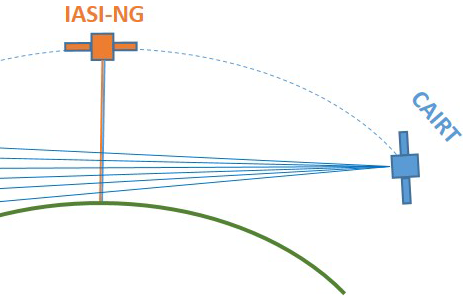
Satellite remote sensing has revolutionized our understanding of Earth’s atmosphere, but merging data from different instruments—each with unique strengths—remains one of the biggest scientific challenges. A new study published in Atmospheric Measurement Techniques (2025) presents a major step forward: the extension of the Complete Data Fusion (CDF) algorithm to tomographic (2D) atmospheric retrievals. This innovation could significantly enhance how scientists integrate limb‑viewing and nadir‑viewing satellite data, ultimately improving our ability to observe and understand complex atmospheric processes. What’s New in This Study? The researchers successfully extended CDF to handle two‑dimensional (2D) tomographic retrieval products. This enables the fusion of datasets that include both vertical and horizontal information—crucial for capturing the geometry of atmospheric structures.To demonstrate this, they tested the method on simulated ozone datasets from two future missions: IASI‑NG (Infrared Atmospheric Sounding Interferometer – New Generation), a nadir‑viewing instrument CAIRT (Changing‑Atmosphere Infrared Tomography), an ESA Earth Explorer 11 candidate mission providing limb tomographic observations. These two sensors observe the atmosphere in very different ways. By combining...
Read More
A New Ozone Dataset to Understand Stratospheric Intrusions: Inside the Latest AMT Publication

A New Ozone Dataset to Understand Stratospheric Intrusions: Inside the Latest AMT Publication

Monitoring the Earth’s ozone layer—especially in the complex region where the upper troposphere meets the lower stratosphere (UTLS)—remains one of the biggest challenges in atmospheric science. A recent study published in Atmospheric Measurement Techniques introduces a breakthrough: a new fused ozone dataset created using Complete Data Fusion (CDF) applied to measurements from the MIPAS and IASI satellite instruments. This innovative approach brings unprecedented clarity to ozone behavior over the Himalayas, a hotspot for stratospheric intrusion events. Guidetti et al. (2026) developed an ozone dataset by combining: MIPAS limb observations aboard ESA’s Envisat satellite, and IASI nadir observations aboard EUMETSAT’s MetOp satellites. These instruments operated simultaneously between 2008 and 2011, providing complementary views of the atmosphere. This fusion—using the Complete Data Fusion algorithm—enhances our ability to detect and quantify ozone variations in the UTLS, a region crucial for understanding climate interactions and air quality. Why Combine MIPAS and IASI?Each instrument sees the atmosphere differently: MIPAS provides high-vertical-resolution limb sounding but with limited spatial coverage. IASI delivers dense global coverage...
Read More